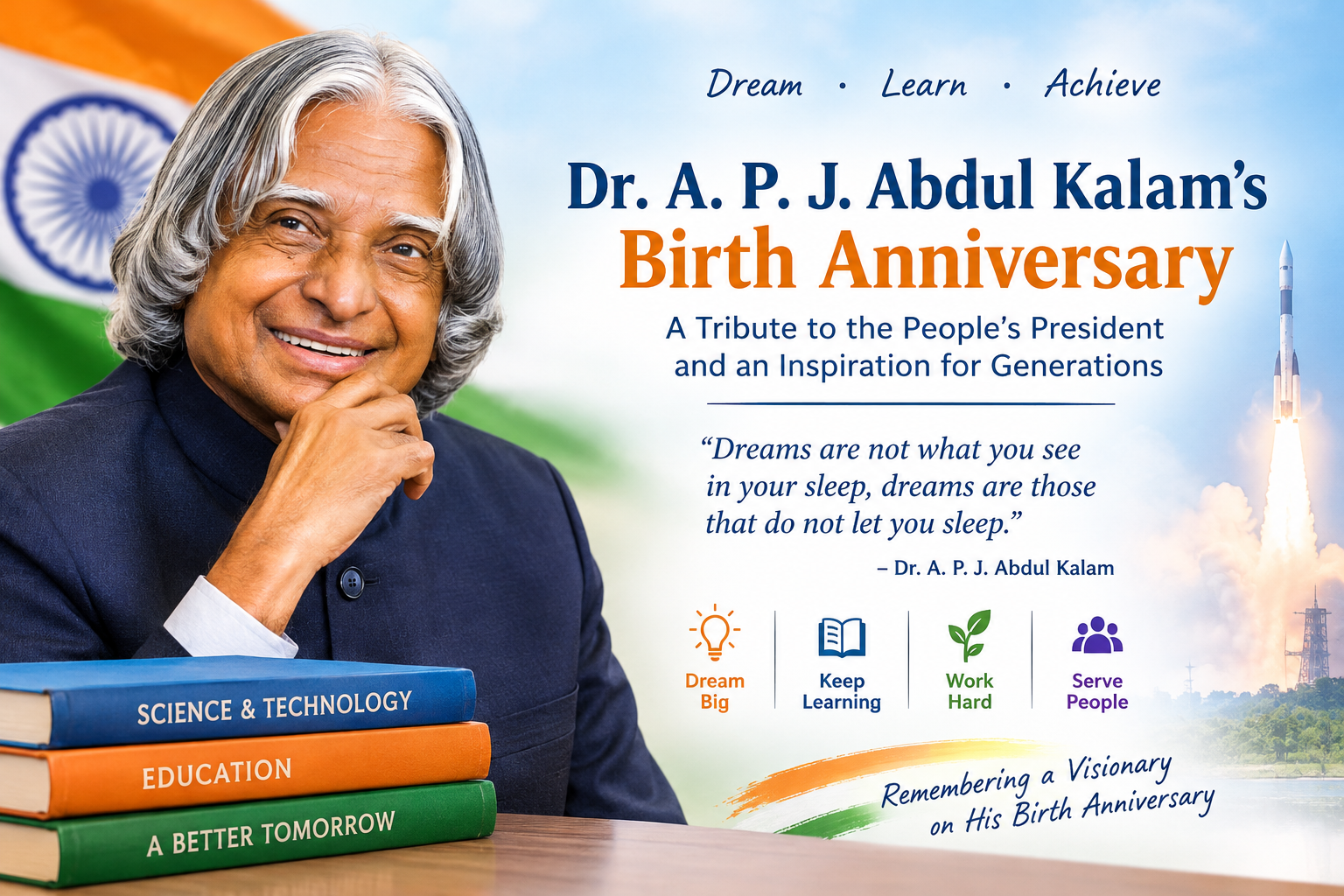
Dr. A. P. J. Abdul Kalam Birth Anniversary. Missile Man Of India.
Thank you for reading this post, don't forget to subscribe!Every year on 15 October, India remembers the birth anniversary of Dr. A. P. J. Abdul Kalam, one of the country’s most respected scientists, teachers and former Presidents. His life story continues to inspire students, young professionals and people who dream of contributing to society. He is remembered not only for his achievements in science but also for his simplicity, dedication and love for education. Dr. A. P. J. Abdul Kalam Birth Anniversary.
Early Life of Missile man of India.
Dr. Avul Pakir Jainulabdeen Abdul Kalam was born on 15 October 1931 in Rameswaram, Tamil Nadu. He grew up in a humble family and learned the importance of discipline, honesty and hard work from an early age. Despite facing financial challenges, he continued his education with determination.
His interest in science and technology guided him towards aerospace engineering. Through continuous learning and perseverance, he built a remarkable career in India’s scientific community.
Contributions to Indian Science and Technology
Dr. Kalam played an important role in strengthening India’s space and defence programmes. His work with the Indian Space Research Organisation (ISRO) and the Defence Research and Development Organisation (DRDO) contributed to the development of important indigenous technologies.
His involvement in India’s missile development programmes earned him the popular title “Missile Man of India.” He also contributed to the country’s scientific progress and encouraged India to become more self-reliant in technology.
His professional achievements demonstrated how scientific knowledge, teamwork and determination can help a nation overcome challenges.
Dr. Kalam as the President of India
In 2002, Dr. Abdul Kalam became the 11th President of India and served until 2007. He earned the affectionate title “People’s President” because of his approachable nature and connection with ordinary citizens, especially students.
Unlike leaders who remain distant from young people, Kalam enjoyed interacting with students and answering their questions. He believed that education, creativity and scientific thinking were essential for building a stronger India.
Even after completing his presidential term, he continued teaching, delivering lectures and encouraging young minds to work towards meaningful goals.
Why Is His Birth Anniversary Important?
Dr. Kalam’s birth anniversary provides an opportunity to remember his achievements and learn from his values. Schools, colleges and educational institutions can observe the day through speeches, essay competitions, science exhibitions, reading activities and discussions about his life.
Students can use this occasion to understand the importance of setting goals, respecting teachers, developing new skills and serving society. His journey reminds us that a person’s background does not have to limit their ambitions.
Lessons We Can Learn from Dr. Kalam
Dr. Kalam’s life offers several valuable lessons:
- Dream with purpose: Set meaningful goals and work consistently towards them.
- Value education: Keep learning and remain curious about the world.
- Accept challenges: Treat difficulties as opportunities to improve.
- Stay humble: Success becomes more meaningful when accompanied by kindness.
- Serve society: Use your knowledge and abilities to help others.
Conclusion
Dr. A. P. J. Abdul Kalam’s birth anniversary is more than a remembrance of a great personality. It is an invitation to follow the path of knowledge, courage, discipline and service. His life continues to show that sincere effort and a strong vision can make a lasting difference.
On 15 October, let us honour this extraordinary Indian by encouraging education, scientific curiosity and responsible citizenship. The best tribute to Dr. Kalam is to turn our dreams into positive actions and contribute to a better future for India.