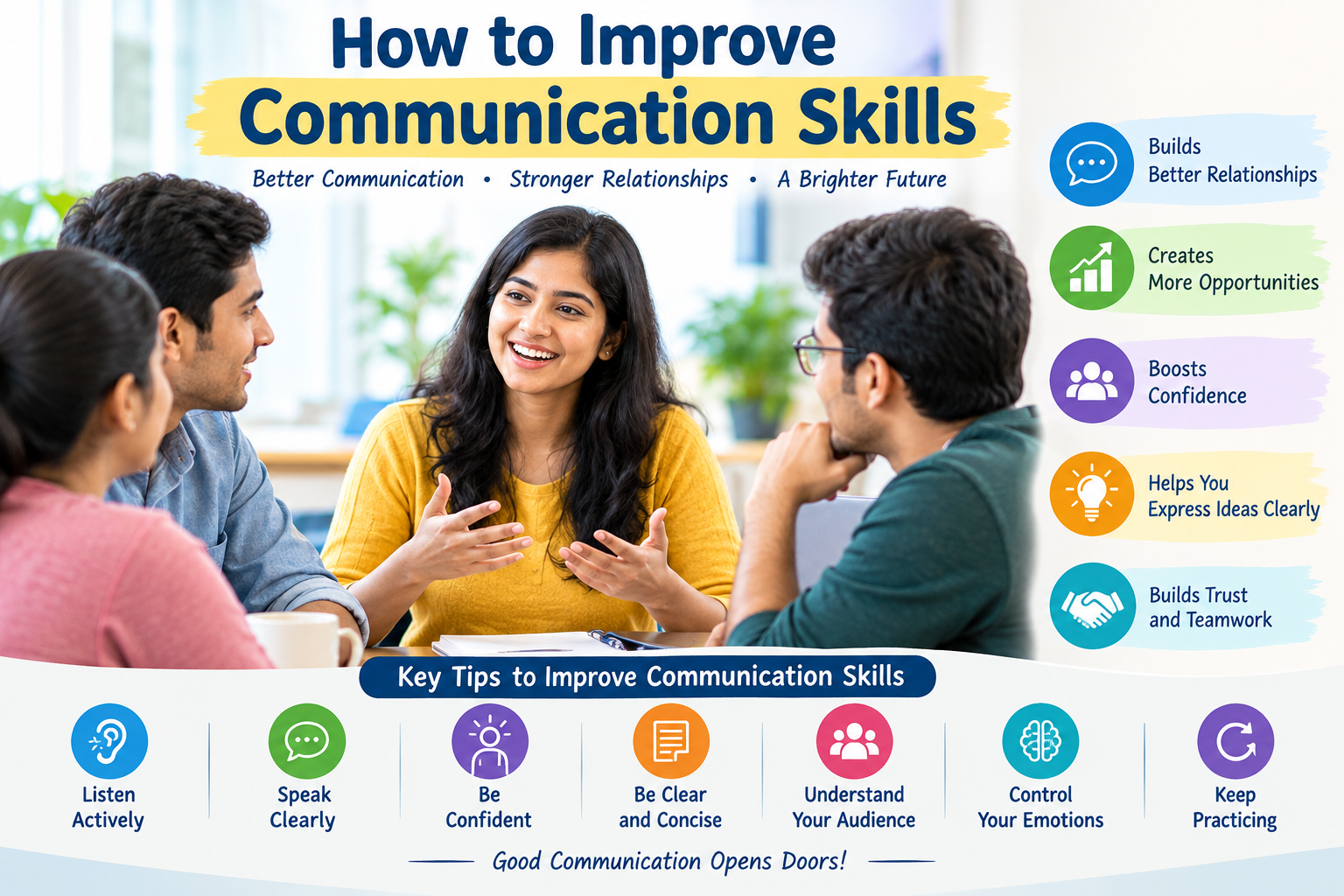
How to Improve Communication Skills: 15 Simple and Practical Ways
Thank you for reading this post, don't forget to subscribe!Communication is an essential skill in everyday life. Whether you are a student, employee, business owner, teacher, manager, or professional, the ability to express your thoughts clearly can make a significant difference in your personal and professional life.
Many people have good knowledge and ideas but struggle to express them effectively. Developing strong communication skills can help you explain your thoughts clearly, build better relationships, handle misunderstandings, work effectively with others, and improve your confidence.
In this article, we will explain how to improve communication skills through simple and practical methods that anyone can practice.
Why Are Communication Skills Important? (How to Improve Communication Skills)
Good communication helps people understand one another. When you communicate clearly, you can share your ideas, feelings, opinions, and instructions more effectively. Developing communication skills from a young age can be particularly useful for students. Strong speaking and communication abilities can help students participate confidently in classrooms, interviews, group discussions, presentations, and future workplaces.
Effective communication can also help you:
- Build strong personal and professional relationships
- Express your ideas with confidence
- Reduce misunderstandings
- Gain the trust of others
- Handle difficult conversations
- Work better as part of a team
- Motivate people around you
- Solve problems more effectively
- Develop leadership qualities
- Perform better in interviews and presentations
- Increase self-confidence
When communication and self-confidence develop together, people are generally better able to present their opinions and influence others in a respectful and effective way.
15 Ways to Improve Communication Skills (How to Improve Communication Skills)
| Sl No | How to improve Communication skills |
| 1 | Be Clear and Concise |
| 2 | Know Your Communication Goal |
| 3 | Understand Your Audience |
| 4 | Think Before You Speak |
| 5 | Use Short Stories to Explain Ideas |
| 6 | Learn to Handle Questions Calmly |
| 7 | Prepare for Possible Questions |
| 8 | Develop Non-Verbal Communication Skills |
| 9 | Become a Good Listener |
| 10 | Always Be Willing to Learn |
| 11 | Practice Short Sentences First |
| 12 | Practice Storytelling |
| 13 | Practice Speaking in Front of a Mirror |
| 14 | Record Yourself on Your Mobile |
| 15 | Practice Every Day |
- Be Clear and Concise
One of the most important communication skills is the ability to explain something clearly without using unnecessary words. Before speaking, think about what you actually want to say. Organize your thoughts and communicate the main point directly. Instead of giving a long and confusing explanation, use simple sentences that your audience can easily understand.
For example:
Instead of saying:
“There are several different reasons why we may not be able to complete this work at the particular time that was initially planned.”
You could say:
“We cannot complete the work on time because we need additional resources.”
Clear and concise communication saves time and reduces confusion.
- Know Your Communication Goal
Before attending a meeting, presentation, interview, or important conversation, determine what you want to accomplish. Ask yourself:
- What is the purpose of this conversation?
- What information do I need to share?
- What response do I expect?
- What action should the audience take afterward?
Knowing your objective helps you communicate with greater focus.
- Understand Your Audience
Good communication is not only about what you say. It is also about how your audience understands your message. Before speaking, consider your audience’s:
- Knowledge level
- Interests
- Expectations
- Concerns
- Background
- Possible questions
You may need to explain the same topic differently to a group of students, employees, customers, or experts.
- Think Before You Speak
Taking a few moments to organize your thoughts can make your communication much more effective. Try to decide:
- What do I want to communicate?
- What is the most important point?
- How should I explain it?
- What questions might people ask?
- How can I respond if someone disagrees?
Preparing in advance can make you feel more confident and reduce unnecessary mistakes.
- Use Short Stories to Explain Ideas
Storytelling is a powerful communication technique.
People often remember stories more easily than a collection of facts. When appropriate, use a short example, real-life situation, or simple story to make your message more interesting. For example, if you are explaining the importance of teamwork, you can describe a situation where a group successfully completed a difficult task by working together. A relevant story can make complicated ideas easier to understand.
- Learn to Handle Questions Calmly
After a presentation or speech, different people may respond in different ways.
Some may ask questions, others may need clarification, while some may disagree with your opinion. Do not become angry or nervous. Listen carefully to the question, understand what the person is asking, and respond politely. If you do not know the answer, it is better to say that you need to check the information rather than provide an incorrect answer. Remaining calm during difficult conversations is an important part of effective communication.
- Prepare for Possible Questions
If you are attending an important meeting or giving a presentation, think about possible questions beforehand. Consider:
- What could the audience misunderstand?
- What information might they want?
- What objections could arise?
- Which points require additional explanation?
Preparing answers in advance can improve your confidence and help you achieve the purpose of your communication.
- Develop Non-Verbal Communication Skills
Communication is not limited to spoken words.
Non-verbal communication includes:
- Facial expressions
- Eye contact
- Hand gestures
- Body posture
- Tone of voice
- Appropriate physical distance
- Overall body language
For example, maintaining appropriate eye contact and an open posture can help you appear more confident and attentive. Your body language should support your spoken message rather than contradict it.
- Become a Good Listener
Listening is one of the most important parts of communication. Some people concentrate so much on preparing their response that they fail to understand what the other person is saying.
Practice active listening by:
- Paying attention
- Avoiding unnecessary interruptions
- Asking relevant questions
- Clarifying information when necessary
- Showing that you understand the speaker
Good listening helps you understand people better and respond more appropriately.
- Always Be Willing to Learn
Communication is a skill that can continuously improve. Even experienced speakers can learn something new from every conversation, presentation, interview, or meeting. Read books, observe effective speakers, listen to informative talks, learn new vocabulary, and ask for constructive feedback. A willingness to learn can help you gradually become a better communicator.
- Practice Short Sentences First
If you are a beginner, do not worry about speaking long and complicated sentences. Start with short, simple sentences. For example:
- “I agree with this idea.”
- “I have another suggestion.”
- “Let me explain my point.”
- “I need more information.”
- “Could you please clarify this?”
Once you become comfortable with short sentences, gradually move toward longer explanations.
- Practice Storytelling
After becoming comfortable with simple sentences, practice telling short stories.
Choose an everyday experience and explain it in a logical order:
Beginning → Situation → Problem → Action → Result
This exercise can improve your vocabulary, sentence formation, confidence, and ability to organize thoughts.
- Practice Speaking in Front of a Mirror
Mirror practice is a simple technique for improving speaking confidence. Stand in front of a mirror and talk about a familiar topic for a few minutes. Observe:
- Your facial expressions
- Eye contact
- Posture
- Hand movements
- Speaking speed
- Confidence
Regular practice can help you become more comfortable with speaking.
- Record Yourself on Your Mobile
Another useful technique is recording yourself while speaking. Choose a topic and make a short video using your mobile phone. Then watch it carefully. Look for areas that you can improve, such as:
- Unclear pronunciation
- Repeated words
- Long pauses
- Speaking too quickly
- Poor posture
- Lack of eye contact
- Unnecessary gestures
Recording yourself allows you to observe your communication from the listener’s perspective.
- Practice Every Day
Communication skills cannot usually be developed overnight. Consistent practice is more valuable than occasional practice. Spend a few minutes every day speaking, reading aloud, listening, storytelling, or recording yourself. You can practice by:
- Talking with friends
- Participating in group discussions
- Reading aloud
- Explaining a topic
- Giving short presentations
- Speaking in front of a mirror
- Recording videos
- Listening carefully to others
Small daily improvements can eventually produce significant results.
Communication Skills for Students
Students can benefit greatly from developing communication skills early. Strong communication can help students participate in class discussions, deliver presentations, attend interviews, work on group projects, and interact confidently with teachers and classmates. Students can start with simple activities such as reading aloud, explaining lessons in their own words, participating in discussions, practicing storytelling, and recording short videos.
These activities can gradually improve speaking ability and confidence.
Communication Skills and Leadership
Effective leaders need strong communication skills. A leader must be able to explain goals, provide instructions, listen to team members, resolve conflicts, motivate people, and make difficult decisions. Clear communication can help teams understand their responsibilities and work toward a common objective. Therefore, improving communication skills can also contribute to the development of leadership abilities.
Final Thoughts (How to Improve Communication Skills)
Good communication is an important life skill that can benefit almost everyone. It helps us express ideas clearly, understand others, build relationships, solve problems, and work effectively with people. The best way to improve communication skills is through regular practice. Start with short sentences, become a better listener, practice storytelling, work on non-verbal communication, use mirror practice, and record yourself speaking. Most importantly, do not be afraid of making mistakes. Communication improves gradually through practice, observation, feedback, and continuous learning.
Start practicing today, and take one small step toward becoming a more confident and effective communicator.
If you want to read how to set goal effectively, you can click below link
https://phonesuddi.com/how-to-set-goals-effectively/